Monday, September 27, 2010

September Anatomy of Pilates Workshop

We invite you to join us for Septembers' monthly wellness workshop! These informative get-togethers are free and open to the community. Join us on September 30th from 5:30-7:00 pm for The Anatomy of Pilates. Take a look, listen and feel of the specific anatomy involved when practicing Pilates, and get better acquainted with the very functional role these bones, muscles and joints play in your posture, strength and youthful suppleness! You will gain a deeper understanding of how your body works and how very powerful your Pilates "Powerhouse" can be!

Coming in October: The Pulley in Pilates!


Saturday, September 25, 2010

TRX Suspension Training

Haven't tried our new TRX Suspension Training classes yet? Don't miss out! Check out our class schedule and make your reservation online!

A terrific complement to your Pilates practice, the TRX Suspension System will challenge your Pilates body to the core. Suspension Training bodyweight exercise develops strength, balance, flexibility and core stability simultaneously. It utilizes the TRX® Suspension Trainer™, a highly portable performance training tool that leverages gravity and the user's body weight to enable hundreds of exercises.

The TRX classes are part of our Open Mat Program, and are limited to 6 participants, so sign-up early to save your spot!

Click here to see a video about TRX Suspension Training.

Wednesday, September 15, 2010

Transitions

The first "exercise" a new client learns when working on the Reformer is how to sit from standing, and then lie down with control and in the proper position. This first lesson begins a commitment to learning "transitions," or the movements that we make between the actual exercises we learn on the Pilates mat and apparatus. These transitions blend one exercise into the next to form a seamless workout. This is one of the unique properties of a True Pilates workout - one of the most important ways that we deepen our workouts into the realm of "artful" as well as mindful movement.

In Pilates we work towards achieving precision and flow. This begins by leaning to transition between exercises on the apparatus -- changing springs efficiently and properly so as not to waste time and energy and to keep the workout moving. We want to achieve a minimum of motion between the exercises to maximize the flow and movement of the complete workout!


Purpose of Transitions
The purpose of transitioning between exercises is to keep the workout moving - to get to that important "flow." In a Pilates workout, even the space between the exercises is exercise. Transitions intensify the workout, develop the flow, and keep you focused on what you're doing. Learning and using transitions moves your Pilates practice to a new level -- to the way that Joe intended -- to a full hour of mindful movement.

Benefits of Transitions
On the apparatus, when you move smoothly from one exercise to the next, (including changing springs, lowering the footbar, etc) you are essentially training yourself to workout without the help of an instructor. You are becoming self-aware and self-sufficent, and you can take the self-sufficent workout with you wherever you go. If you visit another studio, you will know exactly what to do and be "at home" with your Pilates practice.

Another great benefit of learning your transitions is that you will advance in the Pilates method more quickly. Smooth transitions save time, and you'd be surprised how much time is actually left in the hour when transitions are done correctly. That means more time to learn new exercises. In fact, you won't only advance by learning new exercises, but transitioning will put you so deep into "the zone" that your mental workout will advance as well.

Examples of Transitions

-Changing springs on the reformer
-Getting on/off the Reformer, Long Box, Short Box and
Chairs, etc. properly
-Transitions between mat exercises
-Transitions between exercises in the Long Stretch Series,
Stomach Massage Series, etc.
-Lowering the Footbar on the reformer for an efficient
workout
-The transition from coming into the studio standing, to lying down, to standing again

So go for the flow! Work the transitions as if they are truly exercises themselves - to be understood and mastered. Your Pilates practice will be the better for it!

Wednesday, September 1, 2010

Pilates for the Playhouse


The week of July 12th through the 17th, Joe’s Place-True Pilates in East Dennis hosted PILATES FOR THE PLAYHOUSE! - a fundraising event at our studio benefiting the Cape Playhouse in Dennis, MA. With the help of generous contributions, we raised $1800! Last year, Joe’s Place was able to raise over $1500, providing a substantial donation for the local icon. In fact, the event was such a success; Joe’s Place decided to make sure it’s an annual event!!

PILATES FOR THE PLAYHOUSE! featured a full week of donation only Pilates classes, demonstrations on the Pilates apparatus and free trial sessions on the Pilates Reformer. In addition, the event culminated on Saturday, the 18th with a raffle for massages, Pilates classes, Pilates private sessions, lululemon athletica clothing, Arbonne Swiss Skin Products - and a pair of tickets for a night at The Playhouse! The auction also featured donated items and gift certificates for services and products from many generous, local businesses.

The Cape Playhouse is a historical icon in the Dennis Community and on Cape Cod. Celebrating more than 80 seasons, the Cape Playhouse is America's Oldest Professional Summer Theatre. Californian Raymond Moore first brought Broadway to Cape Cod in 1927 when he bought a 19th century former Unitarian Meeting House, moved it to 3 1/2 acres of pasture land fronting the Old Kings Highway (820 Route 6A) in Dennis and converted it into a theatre. The original pews, still serve as seats.

Over the years, the Cape Playhouse has attracted many big name stars from Broadway and the silver screen. Many made their professional stage debuts there, giving it the nickname "The Birthplace of the Stars." Each season of it’s over 80 years, the Playhouse has aimed to bring the best performers, favorite and familiar plays, comedies, mysteries and musicals to the audiences of Cape Cod. The ultimate goal is to guarantee quality, professional entertainment in the form of great theatre, a goal that Joe’s Place-True Pilates firmly supports.

For more information about the annual PILATES FOR THE PLAYHOUSE! fundraiser, contact Joe’s Place-True Pilates at 508-385-8882, or though the website JoesPlaceTruePilates.com. You can also connect with The Cape Playhouse at 508-385-3838 or through CapePlayhouse.com.

Thursday, July 29, 2010

Let's start at the beginning...The Hundred!

The Hundred is one of Pilates most basic, yet important exercises.
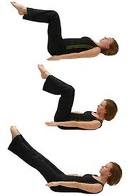
The Hundred is a classic Pilates Exercise. It builds strength, stamina and coordination. Begin by lying on your back with knees bent. Lift your head and shoulders up and forward. Press your arms long at your sides, reaching out just above your hips, and extend your legs out. Scoop your abdominals in and up. You're in position, but do you really understand the exercise you're about to do?

Why is it called The Hundred? During this breathing and circulation exercise, you are going to take ten FULL breaths. While you are doing that breathing, you are lengthening, scooping, and vigorously pumping your arms --five pumps on each inhale and five on each exhale. You'll do one hundred pumps with those arms before the exercise is over! After one hundred pumps, you are warmed up and ready for your Pilates workout!

What are the benefits of The Hundred? The Hundred is the main warm-up exercise in Pilates. The Hundred is always done at the beginning of every Pilates workout -- whether it's on the mat, the reformer, or another apparatus. It is a coordination of breathing and movement, using the control of your powerhouse, that increases your circulation and prepares you for what's to come in your session. When done properly, The Hundred incorporates all of the principles of Pilates that you'll use during the rest of your session, and it exercises your whole body! You will definitely feel the work in your abdominals, but you are also extending your arms and legs and lengthening your spine at the same time.

What if I cannot lengthen my legs out straight? Many people find extending the legs straight out while doing The Hundred to be a challenge. Try working up to this point, starting with "table top" legs - keeping the legs bent at ninety degrees. Once this becomes easy, reach legs straight up to the ceiling, then gradually lower the legs each time you do the exercise after that. Don't try to reach the legs straight out before you're ready, you may strain your back and your form will suffer. Whether you keep the legs bent in (if you are a beginner or have a low back issue) or extend them out, imagine using your abdominals to hold the legs up and to secure your low back in place without allowing it to arch off the mat.

Another challenge is the arm pumping. The pumping itself is not really difficult, but staying in good form can be. It is important to be aware of your position and not get lazy with the pumping. Pumping the arms up and down vigorously is meant to get your heart pumping and blood flowing. Make sure that you're pumping your whole arm, not just "flapping" your hands. Reach from the armpits, curling up to the tips of your shoulder blades. Try not to let your shoulders creep up towards your ears. Feel them slide down your back, onto your back ribs and you scoop the belly in and up. Keep this opposition strong all the way through the exercise. Consciously think of pumping your upper arms up and down, and you will actually feel your abdominals working harder.

Breathing properly during The Hundred is very important. The idea is to take a long inhale (lasting for five arm pumps) and a long exhale (also lasting for five arm pumps). Each time you inhale, try to keep the abdominals engaged, pull the ribs in and don't let them pop up. With each exhale, try to draw your abdominals in a little more. During The Hundred you will inhale and exhale a total of 10 times. Try breathing in through your nose and out through your mouth. Breathing this way filters the inhaled air, improves your concentration, and helps with the deeper abdominal engagement on each exhale.

Keep your eyes on the prize! Look forward at your belly button, and keep your gaze fixed, watching your abdominals deepen in with each exhale. Wrap the thighs and reach the legs long, keeping the knees soft and the feet gently pointed. Imagine the legs getting longer and longer during the entire exercise.

Feeling discomfort in your neck or back as you do The Hundred? Talk to your instructor! There are several simple modifications to rectify this problem - bending your knees or drawing your abdominals in more deeply, using a pillow or ball under your head. There is LOTS of effort to be felt in Pilates, and certainly in doing The Hundred. However, there should NEVER be any pain or true discomfort. Always stop or modify if this is the case.

Beginning your workout by performing your Hundred with control, concentration and strong centering will start you on a positive path to a GREAT Pilates session and a strong Pilates practice!

Enjoy!

Sunday, July 25, 2010

Last Week in the Studio.

As busy as the studio gets in the summer, I never tire of teaching Pilates! I am constantly rediscovering my enthusiasm within the authentic work -- through watching the progress of my clients' practice. Here are a few examples from last week:


Allen conquered the Pull-Up on the Wunda chair. Nicely done!!


My Chairs & Barrels group did a great job this week with the One-Arm Pumping, and started work on their Swans!


And my new client Enzo, discovered some Magic in the Method! Here he is preparing to do his Chest Expansion......


And take a look at the change as he performs the exercise!


Looking forward to starting a great new week tomorrow!! See you there!

Wednesday, July 21, 2010

The Foot Corrector

An often neglected piece of Pilates apparatus, the Foot Corrector deserves far more attention than it receives! Use of this small, simple but fabulous invention helps strengthen and stretch the muscles of the foot and lower leg, as well as correct imbalances in the foot.

The Foot Corrector exercises are generally done in a standing position, one foot at a time, but they may also be done sitting. Feet and ankles should be warm and limber before using the Foot Corrector, so it is best to do your Foot Corrector exercises near or at the end of your Pilates session.

When performing the Foot Corrector exercises, as with exercises on any of the Pilates apparatus, you work the springs, they don't work you! This can be challenging because the exercises are done standing up with the foot on top of the pedal. It's important to imagine the foot working into the pedal, rather than just on top of it. And of course, scoop your abdominals in and up -- away from the downward motion of the foot.

The springs on either side of the pedal may reveal if the inner edge or the outer edge of the foot is stepping harder or sooner. Correcting imbalances like this can help with knee problems and aid in overall stability of the whole body.

Do all the exercises with one foot first, then stand up on both legs and take time to feel the difference between them. It is likely that the leg you just worked will feel longer, as if it is almost "hanging" from your body. The other leg may feel more "bunched up" at the top -- thicker and shorter. You may realize that both legs felt like this before the exercises and you weren't even aware of it!

As with all Pilates apparatus, correct usage is key. Be sure to learn how to properly work with the Foot Corrector -- it is well worth the effort. And, as simple as it looks, it's actually quite a challenge!